

(Part 2) Phonics without the Pressure: Helping a PDA Child Begin to Read
Evidence-Informed, Low-Demand Phonics Strategies for Helping Autistic and PDA Children Learn to Read at Home


Okay so where were we? I ended part 1 of this reading series by asking the question:
‘So… where do I actually begin?’
Let’s get stuck in. This article is going to cover:
Which letter-sounds correspondence to introduce first and why
How to offer meaningful choice in their learning journey
How to build phonics into ordinary life
How to introduce memorable “bonus” correspondences
How to know when to move on
How to support motivation
The phonics principles in this article are informed by reading research. The PDA adaptations are drawn from my nine years teaching Year One (children aged 5-6), my work with home educating families and my experience of home educating two PDA children with contrasting presentations. Research into PDA remains limited, particularly in relation to effective educational support (Haire et al. 2024). So it is important to note that there is currently no research-tested phonics intervention designed specifically for PDA children.
I would also like to reiterate what I wrote in Part 1 of this reading series - there is no one way to learn to read. Home educating families successfully use a wide range of approaches. Some children appear to teach themselves through constant exposure to books, others thrive with whole-language or literature-rich approaches, and many families combine different methods depending on their child’s needs and interests.
This article isn’t intended to suggest that systematic synthetic phonics is the only way to support early reading. Rather, it reflects the approach I know best. As a teacher, I spent nine years teaching children aged four and above to read using systematic synthetic phonics, and it is the approach I continue to use as a foundation with my own children. It has supported my eldest son, who has a PDA profile and is now a fluent reader at almost seven years old, and it is also the approach I have been using successfully with my four-year-old, who is already beginning to read independently.
There are many ways to nurture a love of reading. The reason I have chosen to focus on systematic synthetic phonics is simply because it is the methodology I know best, the one I have seen work consistently with hundreds of children and the one I feel professionally qualified to guide other parents through.
Principle one: Preserve the systematic foundation
The word systematic can sound a little daunting, especially to parents of PDA children who can sometimes find rigid plans threatening as it can reduce their feeling of autonomy. Stay with me here, there is a method to my madness.
Systematic phonics supports beginning readers to connect written graphemes with spoken phonemes and apply this knowledge when decoding unfamiliar words (Castles, Rastle and Nation 2018; Ehri 2020).
To start with, let’s understand what systematic phonics usually involves:
Explicitly connecting graphemes (written letters) with phonemes (the sounds they make), we call these ‘correspondances’
Beginning with a manageable group
Following a planned sequence
Using previously learned correspondences when adding new ones
Moving from individual correspondences into blending (/c/, /a/, /t/ into ‘cat’)
Progressively covering the complete alphabetic code
However, it does not require:
A formal lesson at a fixed time
Worksheets
Sitting at a table
Constant questioning
Progressing at a school-determined pace
Presenting every correspondence in the same way
Obviously all of those things are not inherently bad. If your child likes worksheets at the table (mine did exactly that this morning because they asked me for them) then great. Just don’t feel pressured to do that if it doesn’t work for them. Each child is different and the focus must always be on how the child is experiencing these things. If a formal lesson at a fixed time makes them feel safe and secure in the predictability, then fantastic. If you notice that it is perceived as controlling, then it’s not working for them.
Introduce the starting correspondences
Alright let’s take a look at where we start with all of this.
The correspondences that we begin with sit in letter sounds groups 1 and 2 (all sounds in English can be separated into groups): s, a, t, p, i and n
Great, there they are. Now, how do we understand and talk about them? In four ways:
Phoneme: a spoken sound
Grapheme: a letter or group of letters representing a sound
Blending: combining phonemes to read a word (/c/, /a/, /t/ → ‘cat’)
Segmenting: breaking a word down into individual phonemes (‘cat’ → /c/, /a/, /t/)
Now we know that, we can see how they can quickly be combined into words such as:
at
it
in
sat
sit
pat
tap
pin
nap
pan
Different reading programmes vary slightly in the order in which they suggest the phonemes within sets. The important evidence-informed principles are that the sequence is planned, cumulative and designed to enable early blending… not that every family must use one commercial programme.
For example, many schools used the Letters and Sounds sets, which are organised like this:
Set 1: s, a, t, p
Set 2: i, n, m, d
Set 3: g, o, c, k
Set 4: ck, e, u, r
Set 5: h, b, f, ff, l, ll, ss
But there is no pressure to use a particular programme and it doesn’t need to be as rigid as this. Let me explain…
Principle two: Adapt the route into phonics
Choice within a carefully selected starting point
I will give you an example of how I approached this with my eldest PDA son. I started by offering six appropriate starting correspondences (s, a, t, p, i and n) and I allowed him to choose three. This is a bounded choice that helps to give a feeling of autonomy but still preserves the sequence so that he isn’t immediately discouraged by selecting more complex options. Autonomy can be supported when learners experience meaningful choice and influence, even when necessary boundaries remain (Ryan and Deci 2020). Complete control over the entire phonics sequence would not have been meaningful when he did not yet understand the code. Instead, I offered genuine influence within a manageable and educationally appropriate starting point.
He chose: s, t and p.
He chose to stick them on the wall next to the dining table - excellent choice son! This is a space we sit at every day for our meals and it is in his line of sight. During dinnertime we would play funny games with them and discuss them. We liked to change the name of everything at the table to start with each sound, which made us laugh. It also made it memorable. Humour can be a great, low pressure way into learning for PDA children. We incorporated the sounds into everyday life without turning everything into a twenty minute phonics lesson.
One day we were on the bus and he pointed to the STOP button.
‘Mummy, look! I can see s, t and p!’ he shrieked with joy.
‘Wow, you’re right! But look, there’s another sound in there, I wonder what that is?’ I wondered out loud about the unfamiliar grapheme to give him the opportunity to take ownership over learning a ‘bonus’ correspondence. We made the ‘o’ shape with our mouths and discovered what sound it makes. Then we - for the first time - blended four sounds together to create ‘STOP’. He was over the moon that he had blended an entire environmental word. That day while out and about we looked for it everywhere. We saw it on street signs, we saw it on the front cover of a newspaper, then we saw it again on the bus on the way home. I was not repeatedly asking him to prove what he knew. We were collaboratively noticing how the code appeared in the world around us.
The “Sounds I Already Know” display
As soon as we got home we found the matching card and placed it next to our sounds on the wall.
‘Mummy, I think I need somewhere to put all the sounds I already know. I need some new sounds now.’ he said to me with complete confidence. ‘I’m going to make an ‘already know’ place on the window.
So it was. We had a wall for sounds we were learning, and a window display of all the ones he ‘already knows’. He had taken complete ownership of how his progress was displayed and was chuffed to bits with it. Once he felt confident he moved the sounds to the window display and selected a replacement from the preselected pack of available cards. I always kept a box to the side with three or four replacement cards for him to choose from.
As a parent, I was assessing his progress by looking for a pattern of recognition rather than administering tests or paper assessments. I looked to see whether my child could:
Recognise a grapheme in different contexts
Remember it after a gap of time
Spot it spontaneously in the environment
Connect it with the relevant phoneme
Use it while blending
Within approximately one month, the window display contained six secure correspondences, including the unexpected o.
This visible early success and visual evidence of developing competence drove him forward with a feeling of accomplishment. It made achievement accessible and the confidence it gave him fed into his resilience when we began to move onto trickier correspondences.
‘Bonus’ Correspondances
Occasionally, when I feel that we could do with a boost of momentum or confidence, I slip in a ‘bonus’ correspondence. When I notice that the pace has dropped or the sounds on the wall are particularly tricky, I depart from the conventional order temporarily to follow a memorable connection. Here are some that I keep in my back pocket:
ss, because it represents the familiar /s/ phoneme through a new grapheme
z, paired with buzzing and a zigzag finger movement
o, associated with the shape of the mouth in your pronunciation
x, explored imaginatively through X-Men role play
These memorable detours sit alongside (not instead of) a cumulative phonics sequence. I keep track of the complete sequence so that following curiosity does not leave permanent gaps. These kinds of accessible successes helped my son approach less immediately appealing or visually confusable graphemes, including b and d.
Moving from Correspondence into Reading
So there is a clear progression that we follow with our reading journey, that looks like this:
Play orally with familiar phonemes
Blend two-phoneme words such as at, it and in
Blend three-phoneme words such as sat, pin and tap
Find these words in meaningful contexts, e.g. on the bus!
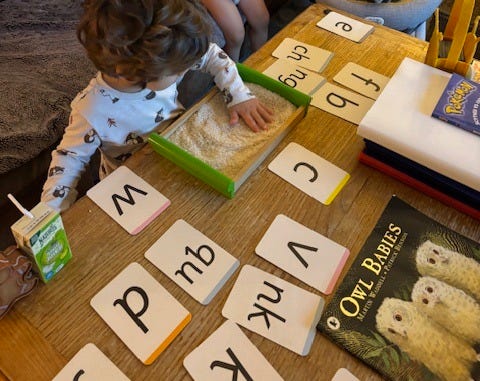
Experiment and play with magnetic letters, letter cards, whiteboards, even writing in rice! (see picture above)
Introduce short decodable books containing known correspondences
Continue reading rich stories aloud for vocabulary, comprehension and enjoyment
Now it’s important to mention here that independent phonics books and shared literature serve different purposes:
Decodable books allow children to apply taught correspondences
Shared stories/reading and audiobooks provide access to language and ideas beyond their independent decoding level and allow them to experience reading for pleasure as well as other purposes
Nothing can replace the joy and connection that reading together can bring. It is honestly one of my favourite parts of being a parent.
Principle four: Discover what makes returning worthwhile
Motivation cannot be standardised
Every home educating parent knows that even a beautifully presented activity will not automatically become accessible to every PDA child. If our children are not motivated to take part then usually that activity is just not happening. Motivation can either be your biggest ally or your greatest challenge with home educating PDA children, so how can we harness it?
Motivation might come from:
Curiosity
Novelty
Humour
Competence
Connection
Independence
Collecting
Mastery
A special interest
Solving a real problem
Meaningful recognition
Now I want to be crystal clear about something here: the goal is not to find a sufficiently powerful incentive to override distress. The question is not, “What can I offer that will make my child comply?” It is, “What helps this particular child experience reading as relevant, achievable and worth returning to?”
Now the answer to this is not the same for every family. I would argue it’s not the same in any family. All I can do here is show you what it looked like in ours, so you might understand the principles behind what may work.
What meaningful recognition looked like in our family
What meaningful recognition looked like in our family
Both of my boys have a strong interest in Pokémon. Anyone parenting a Pokémon enthusiast will know how expensive collecting the cards can become, particularly when you have two children who love them. However, the card-collecting shops in our town have boxes filled with duplicate or unwanted cards. Every couple of months, I ask one of the shops to put together a box for us and make a small donation, usually no more than £10.
My children know that, when we read a book together, they each receive two cards for their collections. In practice, this means that I rarely need to ask them to read. More often, they come to find me, books in hand, because they are excited to discover which cards they will receive afterwards.
Rewards are already woven into conventional education through stickers, certificates, house points, prizes and reading challenges. However, their familiarity does not inherently make them harmless. Research suggests that expected tangible rewards can sometimes become controlling or reduce existing intrinsic interest, depending on the child, the activity and the context in which they are used (Deci, Koestner and Ryan 1999). Conventional reward systems may be particularly unhelpful for PDA children when they make adult control more explicit or turn an activity into another demand.
My intention is not to manage my children’s behaviour or purchase their compliance. The cards recognise the genuine effort they are investing in learning an extraordinarily complex new skill, in a form that is personally meaningful to them. They provide novelty, connect reading with an existing interest and create a tangible record of work in which my children take enormous pride.
The cards are given for participating and practising, not for reading perfectly. Mistakes never result in cards being withheld or previously earned cards being removed, and nobody is expected to continue reading through distress. Reading sessions remain short, mistakes are treated as part of learning and the books themselves remain available without conditions.
When my children look through their collections, they do not describe the cards as something I bought for them. As my eldest once told me:
“I worked really hard for those.”
That sense of ownership matters to him. Nevertheless, this is an example of what has worked in our family… not the method for teaching PDA children to read. Another child might experience the same arrangement as pressure or control.
The transferable principle is not “use Pokémon cards”, but to consider what helps an individual child experience their effort as recognised, their progress as visible and reading as something meaningful enough to return to.
Hyperlexia and Autism
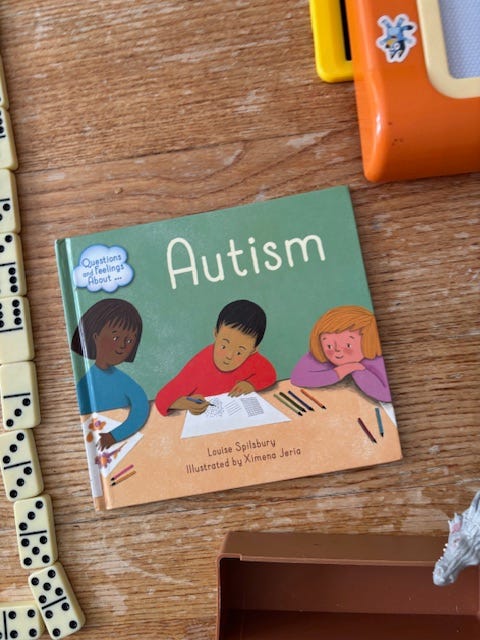
Hyperlexia describes an unusually early and advanced ability to decode written words, often accompanied by an intense interest in letters or written material. A child’s word-reading ability may develop considerably ahead of their broader language or reading comprehension, although individual profiles vary. Hyperlexia has a particularly strong association with autism: approximately 84 per cent of children identified as hyperlexic are thought to be autistic. The relationship does not operate equally in the opposite direction, however. Current estimates suggest that only around 6–14 per cent of autistic children are hyperlexic, although figures vary between studies because definitions and identification criteria are not consistent (Ostrolenk et al. 2017; Cleveland Clinic 2024). This may nevertheless be significant for families reading this article, as some parents may recognise a child who appears to acquire decoding rapidly or independently while still requiring separate support with vocabulary, inference and understanding what they read.
It is also important to explain that my eldest son is hyperlexic. I explicitly taught him the initial grapheme–phoneme correspondences through to Set 5, using the flexible strategies described here, but he subsequently acquired much of the remaining alphabetic code independently. The playful presentation, visible progress and Pokémon cards helped him engage with those early foundations and return regularly to practise, but it would be misleading to attribute his eventual fluency solely to either the cards or my teaching approach. His hyperlexic profile is an important part of his unusually rapid reading development, and his trajectory should not become a benchmark against which another child is measured.
My younger PDA son is not hyperlexic. His progress has been more gradual, but he is nevertheless making excellent progress through the same broad combination of systematic foundations, short and frequent practice, playful delivery, visible success and careful attention to motivation. My eldest son’s progress shows what happened in our family, not what every family should expect to reproduce.
Finding your child’s reason to return
The transferable lesson from our experience is not that families should use Pokémon cards. The cards worked because of the functions they served: they offered novelty, connected reading with something personally meaningful and provided visible evidence of progress. They also created a predictable ending to each short reading session, supported my children’s sense of competence and gave them a reason to return while reading was still effortful. Another child may need something entirely different, or no tangible recognition at all.
A special interest does not have to become something the child earns. It can become the content through which reading develops. A child interested in dinosaurs might read species names and museum labels; a bus enthusiast could explore destinations and timetables; a child who loves baking might follow picture recipes; and a gamer might be motivated to decode character names or instructions. The aim is to discover what makes reading relevant, achievable and worthwhile for the individual child… not what is powerful enough to secure their compliance.
This month’s paid-subscriber resource explores these different routes into motivation in more detail and includes a practical planning tool to help families identify what their own child may need.

Supporting PDA learners with differing presentations
As mentioned previously, my two PDA children could not be more different, this means that I have had to adapt these (already adapted) strategies to further fit their needs. When teaching PDA children to read it is important to recognise any additional needs that may simultaneously require support.
The delivery of their learning needs to be different in order to accommodate:
My externalising child
He may:
Communicates refusal visibly, loudly or aggressively
Negotiate, joke, leave or reject the activity
Has perfectionistic tendencies and low tolerance for mistakes or correction
Respond well to humour, role play, movement and becoming the expert
Is Hyperlexic and autistic
Your internalising child
He may:
Appear to participate willingly
Communicate discomfort more subtly until he bursts into tears
Need me to notice quiet tension, perfectionism or delayed dysregulation
Require me to stop before overt refusal occurs
Is autistic and has suspected ADHD and dyspraxia
So bearing in mind that participation is not always evidence that the level of demand feels manageable, is key.
The same phonics knowledge can be introduced through different routes. The objective is not to discover one universal PDA technique, but to understand the individual child’s communication and capacity. Children displaying extreme demand avoidance can have significantly different educational experiences and support needs, while evidence concerning specific effective interventions remains limited (Truman et al. 2024; Haire et al. 2024). However, you are the expert on your child so are the person best placed to understand their individual needs and accommodate these in the appropriate way.
How do I know if this is working? I hear you ask.
Simple.
Does your child choose to read for pleasure, connection, relaxation, curiosity or exploration? If they do, they have probably developed a great relationship with reading. That’s all we really want at the end of the day. Looking for my sons and finding them nose-deep in a book on their bed because they needed to know what sea snakes eat, brings me (and more importantly, them) deep joy.
A place to begin
Practise pronouncing s, a, t, p, i and n accurately yourself before introducing them.
Offer your child a meaningful choice from this small starting group.
Let them decide where (or whether) the chosen graphemes are displayed.
Notice them naturally in signs, books, packaging and everyday life without repeatedly testing.
Begin blending short words once enough correspondences are familiar.
Make developing competence visible if your child finds this encouraging.
Follow memorable connections while keeping track of the cumulative sequence.
Consider what makes reading personally meaningful and worth returning to.
Keep each experience brief and stop when your child’s capacity changes.
The sequence matters. The route, pace and presentation can belong to the individual child.
Systematic phonics does not have to mean rigid phonics. We can preserve the careful, cumulative teaching of the alphabetic code while remaining flexible about how, when and where a child encounters it. Motivation cannot be standardised, and recognition should never become a means of pushing a child through distress. Some children will progress rapidly, while others need considerably more time, repetition and adaptation; both can represent meaningful success. Ultimately, our responsibility extends beyond teaching children how to decode words. We must also protect their developing relationship with reading.
I am not trying to make my children comply with phonics lessons. I am trying to make the process of becoming a reader accurate, accessible and meaningful enough that they continue choosing to return to it.
With Love,
SENDinMama
More from SENDinMama:
1:1 Support Services: Personalised support services for PDA families
Resources Hub: Printable, PDA, ADHD and SEND friendly tools and Book Lists for Home Education & School
Articles:
Helping Your PDA Child Fall in Love with Reading
·This week, I found myself having almost exactly the same conversation with three different home educating parents of PDA children.

References
Cameron, J., Banko, K. M. and Pierce, W. D. 2001. ‘Pervasive negative effects of rewards on intrinsic motivation: The myth continues’, The Behavior Analyst 24(1): 1–44. https://doi.org/10.1007/BF03392017.
Castles, A., Rastle, K. and Nation, K. 2018. ‘Ending the reading wars: Reading acquisition from novice to expert’, Psychological Science in the Public Interest 19(1): 5–51. https://doi.org/10.1177/1529100618772271.
Cleveland Clinic. 2024. ‘Hyperlexia’. Available at: https://my.clevelandclinic.org/health/diseases/hyperlexia (accessed 8 August 2026).
Deci, E. L., Koestner, R. and Ryan, R. M. 1999. ‘A meta-analytic review of experiments examining the effects of extrinsic rewards on intrinsic motivation’, Psychological Bulletin 125(6): 627–668. https://doi.org/10.1037/0033-2909.125.6.627.
Department for Education. 2024. The Reading Framework: Teaching the Foundations of Literacy. London: Department for Education. Available at: https://www.gov.uk/government/publications/the-reading-framework-teaching-the-foundations-of-literacy (accessed 8 August 2026).
Ehri, L. C. 2020. ‘The science of learning to read words: A case for systematic phonics instruction’, Reading Research Quarterly 55(S1): S45–S60. https://doi.org/10.1002/rrq.334.
Haire, L., Symonds, J., Senior, J. and D’Urso, G. 2024. ‘Methods of studying pathological demand avoidance in children and adolescents: A scoping review’, Frontiers in Education 9: 1230011. https://doi.org/10.3389/feduc.2024.1230011.
Ostrolenk, A., Forgeot d’Arc, B., Jelenic, P., Samson, F. and Mottron, L. 2017. ‘Hyperlexia: Systematic review, neurocognitive modelling, and outcome’, Neuroscience & Biobehavioral Reviews 79: 134–149. https://doi.org/10.1016/j.neubiorev.2017.04.029.
Ryan, R. M. and Deci, E. L. 2020. ‘Intrinsic and extrinsic motivation from a self-determination theory perspective: Definitions, theory, practices, and future directions’, Contemporary Educational Psychology 61: 101860. https://doi.org/10.1016/j.cedpsych.2020.101860.
I love how you have taken something that is really structured and made it more flexible, low demand and accessible.
As a former teacher, I think this is a great resource because I'm sure many parents who are home educating aren't aware of the way in which letter sounds are introduced or why. I also really liked how you included other letters than came up incidentally. I think perhaps there is difficult balance, especially when supporting PDAers, with supporting the development of reading in an optimum systematic way without making it too much of demand and being flexible.
There is lots of evidence for using systemic phonics but I'm assuming that is all based on teaching 4-5 year olds in school to read. I would be curious about whether this would be the same if reading was taught at a later age!